No Knead Bread

on Mar 03, 2023, Updated Feb 28, 2026
This post may contain affiliate links. Please read our disclosure policy.

I posted this No Knead Bread recipe on TikTok on February 12, 2021, not expecting to wake up to 15 million views 🤯. Little did I know that this humble peasant bread, rooted in a history of strength and resourcefulness, would become a 🌎 global sensation, carrying forward my Bapche’s legacy 👵🏼. If you’ve never baked bread before, this is the perfect place to start — it’s simple, beginner-friendly, and surprisingly easy.

Key Takeaways
- The No Knead Bread recipe gained 15 million views on TikTok and honors my family legacy from Bulgaria.
- This recipe requires no kneading and only 5 minutes of active work, making it beginner-friendly.
- You can customize No Knead Bread with variations like gluten-free or sourdough options.
- Serve No Knead Bread with soups, stews, and cheese boards for a delightful pairing.
- Tips include using the correct water temperature for yeast activation and adjusting the dough’s consistency.
Table of Contents
Origins of No Knead Bread
In the heart of Bulgaria 🇧🇬, where a frugal lifestyle was a necessity, basic ingredients—flour, salt, water, and yeast—had our tummies fed and our pockets happy ☺️. My grandma was one of ten siblings so this rustic bread became a lifeline in a very challenging world. The legacy of this no knead bread, called “Selski Hliab” in Bulgarian, persevered through the harsh years of communism when ingredients were scarce but the warmth of freshly baked bread 🥖 was our lifeline.
This bread has been in my family for generations and represents more than just nourishment; it symbolizes the bond between my family and the strength my grandma passed down to us. Though I lost my grandma, who was my soulmate, on November 13, 2020, her memory lives on through our shared moments of laughter, tears, and the simple pleasure of enjoying this bread together. Every time I close my eyes, I can picture her so I hold on to that feeling.
Why You’ll Love No Knead Bread
🥣 No kneading, no stand mixer required. Just a bowl and a spoon — that’s it.
⏲️ Only 5 minutes of active effort. You won’t even get your hands dirty. Mix, cover, and let time do the work.
🍞 A Dutch oven is ideal — but not necessary. It helps create that beautiful crust, but I’ll show you how to make it without one using a baking dish.
👩🍳 Easy to make, without compromising quality. You’ll get a crisp crust and soft, airy crumb that tastes like it came from a bakery.
Nonna’s Tip 🫧
To activate the yeast, dissolve it in warm (not hot) water and let it sit for 5–10 minutes — it should look foamy and bubbly. If nothing happens, it’s best to start fresh.
Variations and Substitutions for No Knead Bread
- Flour Variations: If you’d like a slightly chewier crumb, you can use bread flour instead. For a heartier loaf, substitute up to 50% whole wheat flour and add 1–2 tablespoons of extra water 💧 since whole wheat absorbs more moisture.
- Gluten-Free Option: For all my gluten-free besties, I developed this Gluten Free No Knead Bread with you in mind. Since bread relies on gluten to develop structure, the GF version won’t rise as high as the original and will have a slightly different taste and more density 🥖.
- Yeast Variations: This recipe uses active dry yeast. However, if you prefer instant yeast, you can substitute it in equal amounts and mix it directly into the flour.
- Sourdough Variation: Replace the yeast with ½ cup active sourdough starter and slightly reduce the flour and water to keep the dough balanced. The rise will take longer, and the flavor will be more complex and tangy.
- Flavor Add-Ins: Stir in rosemary and garlic 🧄 before the first rise, fold in chopped olives 🫒, make it extra cheesy, or add 2–3 tablespoons of seeds to the top before baking for extra texture. You can find all of my No Knead Bread recipes below!
More No Knead Bread Recipes

No Knead Olive Bread
6 hrs 5 mins

No Knead Gluten Free Bread
6 hrs 20 mins

No Knead Cheddar Bread
6 hrs 10 mins

No Knead Garlic Bread
4 hrs 10 mins

No Knead Feta Bread
6 hrs 10 mins
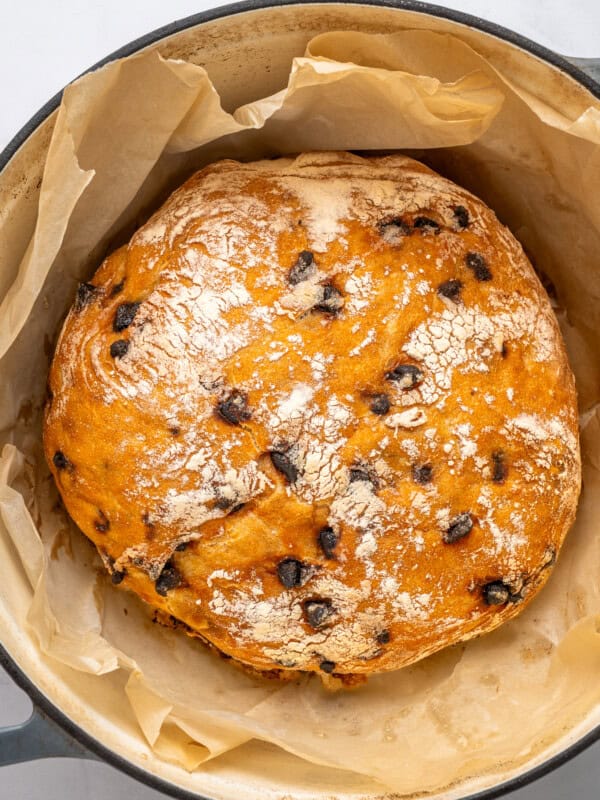
No Knead Chocolate Chip Bread
6 hrs 5 mins
Best Served With
My No Knead Bread pairs wonderfully with a variety of dishes, including soups and stews 🍲, cheese and butter boards 🧀, and more. Some of my favorite soups to enjoy with this bread:
- Pastina Soup
- Greek Lemon Soup
- The Best Lentil Soup
- Hidden Veggie Orzo Soup
- Healthy Cream of Broccoli Soup
- Healthiest Cream of Hidden Veggie Soup
- Hidden Veggie Meatball Soup
- Chicken Noodle Soup
Try it With My Favorite Boards
- Viral Butter Board With Goat Cheese
- Holiday Butter Board
- Holiday Charcuterie Board
- Holiday Cheese Board
Most Common Questions
Maintaining this water temperature range is crucial because it ensures that the yeast activates properly. Water that’s too hot or too cold can hinder yeast activation.
In this traditional recipe, I encourage you to add water gradually until you achieve a very thick and sticky dough, following the “na oko” or “by eye” method.
To test your yeast, add it to warm water. If it doesn’t foam up, you’ll need to start with new yeast. Foaming indicates that the yeast is active and is ready to be added to the flour and salt.
You certainly can. Although this recipe specifically calls for active dry yeast you can also try instant yeast as well.
If the dough is too wet, you can sprinkle in a bit more flour to adjust. Conversely, if it’s too dry, add warm water a little at a time until you have a tacky dough.
Yes, any oven-safe baking dish that can accommodate a loaf of bread will work. For example, a Corning Ware Dish or something similar will do the job.
It’s not necessary. A Dutch oven traps steam, which helps create a crisp crust and strong oven spring. However, you can use a casserole dish or a baking stone with a steam tray as an alternative.
Preheat your Dutch oven in a 450°F (230°C) oven with its lid on, shape the dough, place it inside, bake for 30 minutes with the lid on, then remove the lid and bake for an additional 15-20 minutes until golden brown.
Weighing your flour using a kitchen scale is ideal for accuracy. However, scooping and leveling the flour in a measuring cup can also ensure more precise measurements, helping you achieve the right consistency for the dough.
While I have not explicitly tested it, aluminum foil should work as a substitute for a dish lid.
Yes, you can use 1-1 gluten-free flour for this recipe, or you can make my No-Knead Gluten-Free Bread.
The dough should rest for a minimum of 5 hours, but it’s common to leave it overnight and bake it the following morning, typically at room temperature away from drafts.
In hotter climates, the dough may rise much faster, so I would advise placing it in a cooler room or limiting the rise to a maximum of 2 to 3 hours to prevent over-expansion. Once it doubles or triples in size, it should be baked immediately.
The recipe hasn’t been tested at higher altitudes, so adjustments may be necessary.
The dough should have a thick and sticky consistency. If it’s too dry, add a splash of water at a time until the dough is tacky. Too wet? Add a sprinkle of flour at a time until you reach the desired consistency.
No Knead Bread

Ingredients
- 3 cups all purpose flour, plus more for dusting the counter and top of the bread
- 1 teaspoon salt
- ½ teaspoon active dry yeast , check the expiration; see notes below
- 1 ¾ cups warm water, between 100 and 110 degrees Fahrenheit (37 to 43 degrees Celsius)
- additional flour for dusting the counter plus the top of the bread , no kneading, dust the top and bottom well, gently shape and transfer
Instructions
- In a large mixing bowl, combine the flour, salt, and yeast. Mix with a whisk, wooden spoon, or with clean hands.
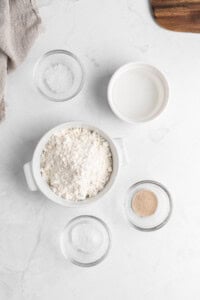
- Add the water and mix with a spatula until you have a sticky dough. Cover the bowl with a clean kitchen towel and let rest at room temperature for at least 5 hours or overnight. Place the bowl of dough away from drafty areas, such as in the microwave, cupboard, or in a cold oven.
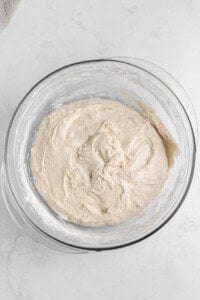
- Note: The water must be between 100 and 110 degrees Fahrenheit (37 to 43 degrees Celsius). If the water is too hot or too cold the yeast will not activate.
- After the dough has tripled in size, uncover it, and flour the counter. Pour the dough out onto the counter and generously sprinkle the top with flour.
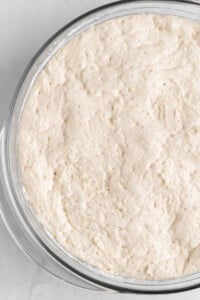
- Note: You do NOT need to knead the dough. You can simply move it around until you have a really nice and soft dough that is no longer sticky and is oval in shape. If the loaf sticks to your hands or the counter, sprinkle on a little more flour.
- Place the loaf into any oven-safe dish lined with parchment paper. Place a lid on the dish, and place the dish in a cold oven (an oven that is NOT preheated).
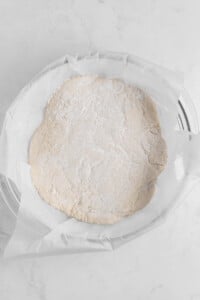
- Turn the oven on to 450F (230C) once the bread is inside. Bake the bread with the lid on the dish for 30 minutes. After 30 minutes, carefully remove the hot lid from the dish and bake the bread for another 25 to 30 minutes.
- Baking note: The bake time will depend on your oven, so keep an eye on it. Total bake time will be about 1 hour from the moment you place the bread into the cold oven.
- The bread is done once it’s light and golden all over. Let it cool for 5 to 10 minutes and enjoy!
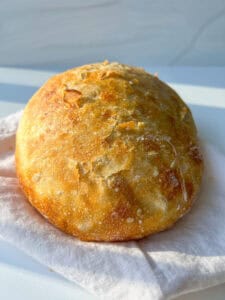
- Storage note: To store leftover bread, let it cool completely, wrap it up in plastic wrap, beeswax wrap, or a clean kitchen towel, and store the bread on the counter. This bread is always best served warm the same day.
Nonna’s Notes
- Flour Variations: If you’d like a slightly chewier crumb, you can use bread flour instead. For a heartier loaf, substitute up to 50% whole wheat flour and add 1–2 tablespoons of extra water 💧 since whole wheat absorbs more moisture.
- Gluten-Free Option: For all my gluten-free besties, I developed this Gluten Free No Knead Bread with you in mind. Since bread relies on gluten to develop structure, the GF version won’t rise as high as the original and will have a slightly different taste and more density 🥖.
- Yeast Variations: This recipe uses active dry yeast. However, if you prefer instant yeast, you can substitute it in equal amounts and mix it directly into the flour.
- Sourdough Variation: Replace the yeast with ½ cup active sourdough starter and slightly reduce the flour and water to keep the dough balanced. The rise will take longer, and the flavor will be more complex and tangy.
- Flavor Add-Ins: Stir in rosemary and garlic 🧄 before the first rise, fold in chopped olives 🫒, make it extra cheesy, or add 2–3 tablespoons of seeds to the top before baking for extra texture. You can find all of my No Knead Bread recipes when you scroll up the post!
My Notes
Nutrition
Nutrition information is automatically calculated, so should only be used as an approximation.



Thank you for sharing such a beautiful recipe from a beautiful soul. Love this idea! It sounds so simple and I love reading all the reviews.
Have you ever done any additions to it? Folding in roasted garlic? Olives? Rosemary like some of boules at the market?
Hi Andrea, yes I actually have a cheese loaf recipe up and an olive one too! You can make this bread with any additions that you like 🙂
Hi really love all your videos!! I made the no knead bread today & it was very quick and easy, only thing- I think my oven was too hot, I should have removed it a lot sooner but it had 17 minutes left to go until all baked. It was in for 30 plus 8 minutes in total and it looked like yours. I was worried it would be undercooked inside so I kept it in and it got darker.
I just cut into it and it’s really good. I’ll definitely make it again but remove it earlier & hope it will be cooked inside.
Hi Maria,
yes definitely always keep an eye on it as it depends on the oven. Mine is a lot older and probably weaker
What would cause my bread to crack on top during the covered baking period?
I am using an Emile Henry loaf pan
Hi Anna, what was the end result like? Should be normal as it expands but it shouldn’t have altered the taste/texture
Is the parchment paper a necessity? I don’t have any.
It’s there so that it doesn’t stick. I haven’t tried making this bread without it
My bread did not rise past 3”. It fluffed and there were bubbles and I’ve made sourdough breads with all sorts of flavors before. I baked it anyway and still, flat and hard. I had new yeast and good flour. Used a thermometer for temp and scale for dry ingredients. Not sure what went wrong. It proofed for 9hrs.
Hi Jen, it’s really hard for me to tell but sometimes the yeast is bad even if it’s new. please proof it if that’s the case before you add it in. I hope you try again
I had the exact same experience. New yeast, weighed the flour, used a thermometer for the water. It doubled after 10 hours but was still essentially a batter, not a dough.
Hi Nancy, sorry to hear you’re having trouble with the recipe. Please see my recipe notes below the recipe and add a bit more flour if the dough is too soft.
Help! I tried to make this twice, but after proofing it and using some flour. It is still so sticky, it doesn’t shape up like in your video. That in the end it’s like a blob and I am afraid to keep adding flour as it may change consistency. What am I doing wrong or how much flour is too much just to get it to shape into an oval and smooth like your video? Thanks in advance.
Hi Sheryl,
for most accurate results please weigh the ingredients on a scale. The dough should be sticky, it should be dusted with flour and gently shaped and transferred right away into a baking dish.
My dear Nonna I am completely beside myself. For years, I have dreamed of making bread at home, but I was always intimidated by the process. I am late to your party, but luckily found this recipe you have shared with the world and I have made this bread 3 times in the last week! Your videos, blog and content are all on point to say the very least. Please know that you have changed our lives with your love of cooking. Thank you for sharing your recipes with all of us to enjoy. I wish I found your work sooner <3.
Aw Tori,
this made my eyes water and tugged at my heart! Your words mean so much to me, thank you from the bottom of my heart!
Sorry if asked already, Can I halve the recipe?
Hi Sanjeeta, the recipe is right here on my website
I think she means can she cut the recipe in half and make a small loaf. Though why she would want to do that is beyond my understanding. Of course you can, but you will have to watch your time in the oven and take it out when golden and hollow sounding when you tap the crust. Follow all other instructions exactly.
So delicious!! Its crunchy on the outside and so soft on the inside! I couldn’t help myself…. I had two pieces with butter while it was still warm. So easy to make and so tasty! I mixed it last night around 10pm and baked it at 9am this morning. Will definitely be making it again this Sunday for Easter with my family. I come from a Portuguese family full of bakers. My mom always made delicious bread… the old fashioned way…. kneading, kneading. I have two bad shoulders so it was difficult to make bread. Now I can!! Thank you!
Hi Isabel,
such a kind review. Thanks love
WOW, I’ve tried many different bread recipes, this one is my fav so far. Couldn’t stop eating!
Make it exactly as shown here…..trick is def not turning on oven until after you place in the oven. I was also so tempted to let it rise again, but didn’t, turned out perfect ….and made it twice now. Easiest bread recipe I know!
Hi Lori! Thank you for the kind words. So happy the bread was amazing