How to Poach Eggs

on Mar 30, 2022, Updated Nov 07, 2025
This post may contain affiliate links. Please read our disclosure policy.



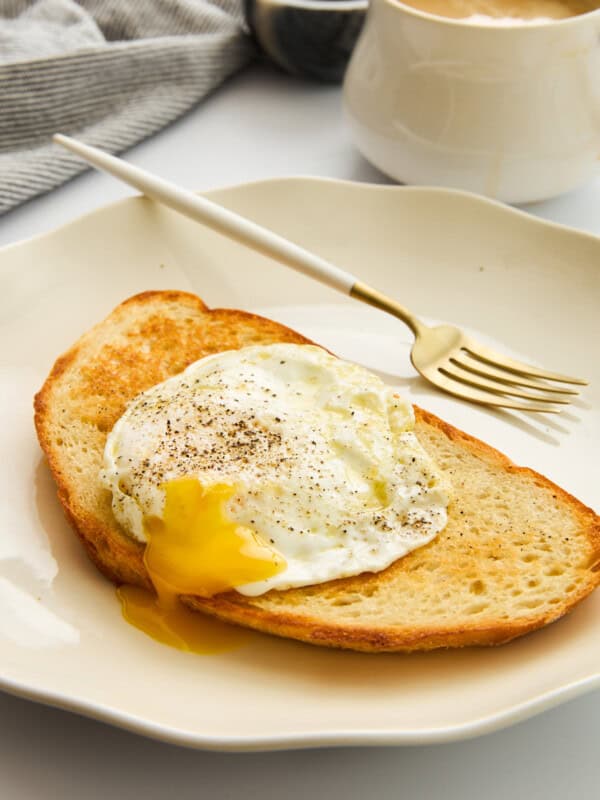
Poaching eggs can be tricky but my easy tutorial on how to poach eggs yields perfect eggs in just five minutes ⏳. This foolproof method that works like a charm every time! Whether you are making eggs benedict, Turkish eggs, or just poached eggs on toast, you can expect perfect round eggs with creamy yolks 🍳.
Key Takeaways
- Strain the eggs in a fine mesh sieve for a better shape, and consider using vinegar in the water for added stability.
- Adjust the cooking time based on whether you prefer firm or runny yolks, and dry the eggs on a paper towel before serving.
- You can poach two eggs at once but ensure the water is simmering, not boiling, for best results.
Table of Contents
Why You’ll Love Poached Eggs
It’s no secret that poached eggs can be tricky. This easy and effortless poached egg recipe makes sure that your eggs come out perfectly cooked each and every time. Poached eggs are a very quick, low-mess, easy way to get in some delicious protein. Poached eggs require zero added cooking fats, and they cook in under 5 minutes.
How to Poach Eggs Tips
- How firm or runny your egg is will depend on how long you leave it in the simmering water. If the yolk feels firm to the touch, it’s definitely well done⠀⠀⠀⠀⠀⠀⠀⠀⠀
- Straining for about a minute in a fine mesh sieve allows the runny egg whites to pass through, leaving only the firmer part of the white behind which in return makes a perfectly shaped poached egg⠀⠀⠀⠀⠀⠀⠀⠀⠀⠀
- You do not need to add vinegar to the water but I always do. And no, the eggs will not taste like vinegar by any means⠀⠀⠀⠀⠀⠀
- Set the poached egg on a paper towel before you serve to remove excess moisture before serving⠀
- You can definitely add two eggs at a time using this method but be sure to gently place them in and make sure the water is simmering, not boiling
Nonna’s Tip 🥚
Straining the raw eggs for about 1 minute in a fine mesh sieve allows the runny whites to pass through, leaving only the firmer part of the white behind which in return makes a perfectly shaped poached egg.

Best Served With
- Try my Ramen Noodle Soup with a perfectly poached egg on top.
- For a low-carb lunch option, you could also use poached eggs to make my Egg Sandwiches.
- Additionally, you can add poached eggs on top of any of my Salads.
- My savory Turkish Eggs are the perfect recipe to showcase poached eggs.
Other Hacks and Recipes
Over Medium Eggs
5 mins

How to Cut Deviled Eggs
15 mins

Boiled Egg Peel Hack
10 mins

Easy Peel Hard Boiled Eggs
12 mins
No you don’t, but keep in mind that you won’t be left with the perfect shape.
No, the eggs will definitely not taste like vinegar but you can absolutely leave it out if you want to.
The vinegar helps the egg hold it’s shape better but you don’t need to use it if you don’t have any on hand.
I like to gently pull the egg out of the water and touch it with one finger to see how soft or well done the yolk is, so if it feels too soft, put it back into the pot.
Swirling the water, or creating a vortex, is supposed to help the egg maintain a nice round shape while cooking. This step is completely optional.
Do not overcook the eggs. Poached eggs cook super fast. You can check for your desired level of doneness by gently bringing the poached eggs to the surface of the water (using a slotted spoon) and gently jiggling them. The more jiggly the egg, the runnier the yolk will be.
A few reasons: the bowl will catch any shell that gets stuck in the egg. And transferring an egg into simmering water without breaking the yolk is much easier to do from a bowl, than directly out of the shell.
How to Poach Eggs
Equipment
Instructions
- Over a bowl crack the egg through a fine mesh sieve. This will allow the loose egg whites to separate. You can save the loose egg whites for another recipe.
- In a pot on the stove add about 4 inches of water and let it come to a simmer.
- Add the vinegar, if using, and as it simmers give it a little swirl with a spoon.
- Gently add the egg to the water and set the timer for five minutes.
- Remove the egg with a slotted spoon and set it onto a plate with paper towel. Increase the time accordingly if you like a firm egg and not a runny yolk.
- Enjoy on toast, salads, English muffins or any other way.
Nonna’s Notes
- Season it: Adding salt to the cooking water is not necessary, but once the egg is done cooking, you can season however you like. I enjoy salt, pepper, and sometimes hot sauce too.
- Any pot will do: You don’t need fancy equipment to make poached eggs. Any pot or pan that is made for the stovetop and which will hold 4 inches of water will work. No lid necessary.
- Make it ahead: Did you know you can make poached eggs in advance? Store cooked, poached eggs in the fridge for up to 2 days, then reheat in a warm water bath. (Microwaving will overcook them.)
My Notes
Nutrition
Nutrition information is automatically calculated, so should only be used as an approximation.


Mine turned out PERFECT!
Didn’t know poaching eggs was this easy, thank you!
Thank you for sharing this recipe
Thank you Didi! 🥹
Hello!
Thank you for the recipe!
I was wondering, how high should the heat be when you add the egg in the water please? (Medium/do you turn it off?)
The water should be simmering. Medium-low 🙂 You don’t want it to be vagarous