Homemade Chicken Bouillon Cubes

on Nov 03, 2023
This post may contain affiliate links. Please read our disclosure policy.

Imagine having your own homemade healthy chicken bouillon cubes made from wholesome, natural ingredients with just a few simple steps!? Well, I’m here to blow your mind 🤯. No longer will you need to read through the long list of mysterious ingredients on the back of those store-bought stock cubes.
Get ready to revolutionize your seasoning game with these nutritious flavour bombs that will add incredible layers of flavor to your soups 🍜, stews, sauces, gravies and more!
Why You’ll Love Chicken Bouillon Cubes
Not only are these homemade chicken bouillon cubes budget-friendly, but they can last for 3-4 months without any preservatives. Speaking of preservatives, did you know most commercial bouillon cubes have up to 500 mg of sodium per cube 😱?!
My homemade chicken bouillon cubes dish up an impressive 12 mg of sodium per serving and are made without any additives, artificial colouring or flavour enhancers. Just some good old simple kitchen staples as ingredients and a blender to fuse it all together.
The best part is that these are completely customizable. You can use any cut of chicken 🐓you prefer, swap out the vegetables, add or remove spices – it’s entirely up to you. So why not give it a try and enjoy the goodness of homemade bouillon cubes without worrying about preservatives and excess sodium 🧂?
How to Prepare Chicken Bouillon Cubes
To prepare these chicken bouillon cubes start by adding the vegetables to a large pot of water on the stove, and turning the heat 🔥 to medium-high.
Let the soup come to a boil, add the chicken and salt, reduce the heat to low, and let the concoction simmer for a minimum of 45 minutes.
After this duration, carefully remove the chicken 🍗 and let the broth and vegetables cool. The tender-boiled chicken is perfect as a salad topper or can be repurposed in my Chicken Salad recipe.
Once cooled, remove the vegetables from the broth using a slotted spoon 🥄 and add them to a blender along with some of that delicious chickeny broth.
Blend the mixture until it reaches a smooth consistency, pour into an ice-cube tray and freeze ❄️.
Once frozen, either cover the ice-cube tray with a lid if available or transfer the frozen cubes into a large Ziplock bag for convenient freezer storage.
Nonna’s Tip 🤌
Make sure to cool the veggies and the broth before blending. Adding hot liquids to a blender is dangerous as heat can cause expansion.

Variations and Substitutions
Here are some ways you can make these homemade chicken bouillon cubes your own:
- Experiment with different flavor profiles by adding other vegetables like mushrooms 🍄, bell peppers, fennel, butternut squash, sweet potato 🍠, or anything else that’s lying around in your fridge.
- If you don’t want to use chicken, feel free to use other meats such as beef, turkey, or fish to make the stock.
- If you’d like to make this vegan or vegetarian-friendly, omit the meat entirely and make my Vegetable Stock Cubes!
- Add herbs and spices 🌿 to enhance the flavor. Some great additions would be thyme, rosemary, bay leaves, parsley, cayenne pepper, coriander seeds, black peppercorns, or even some ginger for an extra immuno-boost.
- Instead of salt 🧂, you can use alternatives such as nutritional yeast, soy sauce, tamari, or even Vegeta (my Eastern Europeans know 😉).
- Consider making different shapes and sizes of the cubes. Larger cubes might be suitable for big batches of soups and stews, while smaller cubes might be appropriate for quick seasoning.
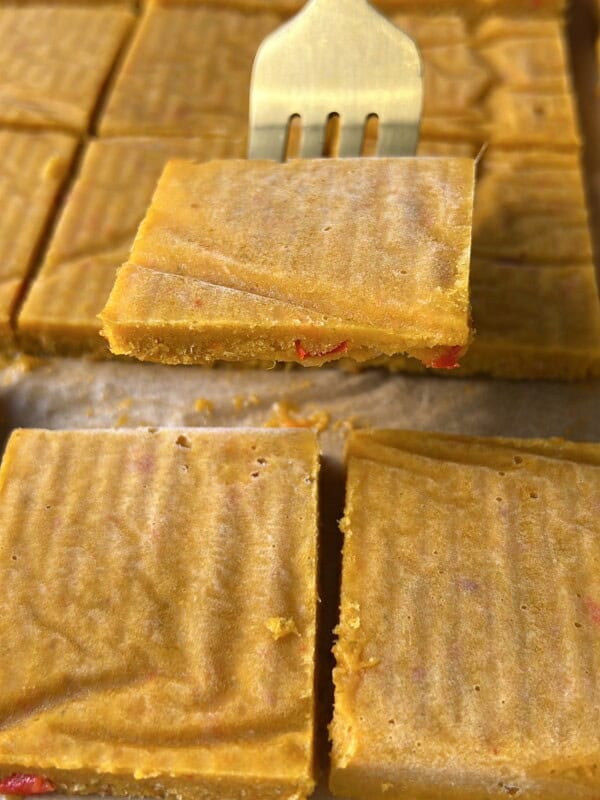
- If an ice-cube tray is not available, consider using a baking sheet. Line the baking dish with parchment paper, spread the purée evenly using a silicone spatula or spoon, and freeze ❄️ until solid. Remove the frozen block from the baking sheet and cut it into equal-sized squares. Wrap each square into foil (or parchment paper on top of foil) and transfer them into a Ziplock bag ready to be stored in the freezer.
How To Use These Chicken Bouillon Cubes
- Throw them into rice 🍚 as it cooks for extra flavor.
- Add 1-2 squares to a cup and pour hot water on top. You can add a pinch of salt and sip away when you feel under the weather.
- Sneak it into pasta sauces for picky eaters. You can also take a look at my Hidden Veggie Pasta Sauce.
- Use it as a base for any bean or lentil stew 🍲. A perfect example would be my Coconut Chickpea Stew.
- Make Pastina Soup by adding 1-2 cubes to a pot of water, then add the salt and pastina. When the pastina has cooked, take it off the heat and add grated Parmigiano on top. Enjoy!
Best Served With

The Best Chicken Soup Ever
1 hr 50 mins

The Best Lentil Soup
50 mins

Hidden Veggie Pasta Sauce
35 mins

Creamy Coconut Chickpeas
15 mins
Similar Recipes
Vegetable Stock Cubes
2 hrs 25 mins

Hidden Veggie Orzo Soup
1 hr 5 mins

Hidden Veggie Soup
50 mins

Easy Pastina Soup
50 mins

Common Questions
Yes, you can definitely use other vegetables. Either add to the vegetables I used in this recipe or substitute them with what you have in the fridge. Some suggestions are mushrooms, bell peppers, fennel, butternut squash, or sweet potato.
Absolutely! Instead of chicken, consider using beef, turkey or even fish.
You most definitely can! To make this recipe vegetarian, simply omit the meat. You can also check out my Vegetable Stock Cubes!
Yes, a stick blender or immersion blender will work, but keep in mind the texture may not be as smooth.
My favourite silicone ice-cube mold is linked HERE!
Yes, you can use any ice-cube tray or silicone mold. Feel free to experiment with different shapes or sizes. Keep in mind that a silicone mold will be easier to work with as the cubes slide right out, while a plastic tray is more rigid.
If an ice-cube tray is not available, consider using a baking sheet instead. Line the baking dish with parchment paper, spread the purée evenly using a silicone spatula or spoon, and freeze until solid. Remove the frozen block from the baking sheet and cut it into equal-sized squares. Wrap each square into foil (or parchment paper on top of foil) and then transfer them into a Ziplock bag ready to be stored in the freezer.
These frozen stock cubes will last in the freezer for up to 3-4 months.
Homemade Chicken Bouillon Cubes

Ingredients
- 2 celery ribs, washed and cut in half
- 2 carrots , washed, peeled, and cut
- 1 onion, whole, peeled
- 1 leek, washed, cut in half and quartered
- 5 garlic cloves, measure with your heart
- 8 cups water , you can also add less
- 6 chicken thighs , boneless, skinless but you can add any cut of chicken that you enjoy
- salt , to taste
Instructions
- In a large pot, add the water. Add the vegetables and put the soup on the stove.
- Turn the heat on medium-high and let it come to a boil.
- Add the chicken and salt. Reduce the heat to low and let it simmer for a minimum of 45 minutes.
- After 45 minutes, take out the chicken. You can use the chicken in salads or for any other recipe like my Chicken Salad.
- Let the broth and the veggies cool.
- Once cooled, take out the veggies with a slotted spoon and add them to a blender with some of the broth.
- Blend until smooth. Pour into a large ice-cube tray and freeze.
- Once frozen, you can cover with a lid if your tray has one or transfer into a large Ziplock bag.
- Note: the cubes will last you for months. The quantity will depend on how big the ice-cube trays are and how much water evaporates during cooking.
My Notes
Nutrition
Nutrition information is automatically calculated, so should only be used as an approximation.


I have a question. How many do you use compared to store bought cubes?
Hi, Marilee! It depends on the size of your ice cube tray. Larger cubes will be for large pots of soup, and smaller ones are more for individual servings. ❤️
Hi! I’m wondering if I could dehydrate this and turn into a powder?
That sounds like a great idea! If you decide to experiment, let me know how it turns out ❤️!
Hi MN
love this recipe, making for my Dad (88) just had a heart valve replacement and needs low sodium foods now 🙁 it is a hard switch for my Dad who has always LOVED salt. I am wondering if you may have any suggestions on how I can make a low sodium chicken gravy maybe using these bullion’s??
Thank you for sharing this great recipe
Hi Jo, oh my gosh, I hope your dad is recovering well! What a sweet idea! Yes, you can follow my gravy recipe and where it calls for unsalted broth, you can use the bouillon cubes (just stir them into warm water): https://themodernnonna.com/easy-gravy-recipe/
💗💗💗
Meausure with your heart, that’s the kind of support I need in my life <3
This recipe is just the best! I can’t believe really how simple it is to make homemade bouillon cubes and they can be used for so many dishes. I keep the boiled chicken and make a quick chicken salad for lunch so nothing goes to waste.
Can’t wait to try! Would using bone-in thighs render a deeper flavour?
Yes, I think so! Please let us know how it goes, Gina.
Do you eat the chicken cooked in this recipe? Just wondering since the broth didn’t look super developed, so maybe the chicken is still good to eat (versus for normal stock where they say all the nutrients have transferred to the stock?) just curious thanks!
Yes, the cooked chicken is delicious and you can use it in salads or make chicken salad with it: https://themodernnonna.com/chicken-lettuce-cups/
I am so excited! Just made a batch of chicken bouillon cubes and I can’t wait to make turkey soup on Friday with leftover turkey! I couldn’t stop tasting it! Many soups are dangerous for me due to the sodium content of bouillon cubes with my hypertension! Not now! I’ll let you know how it turns out. Please send me a soup recipe or I’ll just find one on your site. Not sure if I should add carrots and celery again….definitely escarole! ❤️
Happy Thanksgiving!
Stephanie
Hi Stephanie, I cant wait to hear back from you!
Hi Sneji, in the instructions you only blend a little of the water with the vegetables. Do you add this purée back to the stock and mix together and use that for cubes, or only the stock that was blended with the vegetables ? Seems like the remaining stock should be used,?
Hi Carole, I only add a little bit of broth so that they blend and then I add it back into the soup pot with the remaining broth 🙂
You really should update the recipe to include the step to add the puree from the blender back into the pot. As written, it instructs your readers to pour the puree into cubes, not mix the puree with the stock in the pot and THEN freeze.
Thanks for bringing this to my attention, Joe. I streamlined this process to make it as easy as possible, so the steps are as follows: Cook the chicken and veggies in water; Add veggies to the blender WITH some of the broth (so you don’t have to pour it back into the pot); then pour into cubes. Hope this helps! 😊
“So you don’t have to pour it back into the pot”?
It’s unclear at this point if the remaining broth in the pot is used for the stock or discarded?
Think I’ll look elsewhere for a clear and concise recipe. This one seems wasteful and I’m sure I read elsewhere that it can be reduced down further to a more concentrated stock.
I would’ve added the blended veg/broth mix back into the broth pot. Otherwise it just seems to be mushed up veg?
I regularly make bone broth and nothing is discarded other than the bones and any scum build up on the surface. I was merely looking for tips for making into stock cubes but I’m not convinced with this?!